
A bag's edge is a small detail you can spend years looking at: around the flap, along a handle or beside the opening you reach through every morning.
When choosing a leather bag or a leather briefcase for work, give that narrow line a little of the attention you give the color and shape.
Folded and painted edges offer different visual pleasures.
One lets leather travel around the boundary; the other gives the cut edge its own finish.
Understanding the distinction makes it easier to recognize what appeals to you and ask the seller a useful question beyond "Is this good quality?"
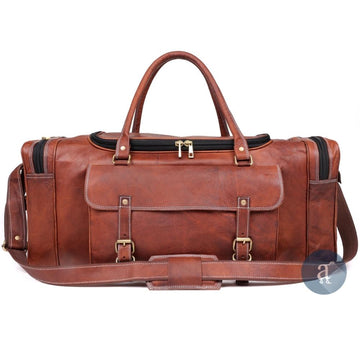
The same checks apply when you compare soft leather travel bags, such as The Traveler, a leather travel duffle bag in top-grain buffalo leather, or a small piece like the Luxe toiletry bag.
First, identify what you are looking at
In a folded edge, the leather turns back on itself, covering the cut boundary.
Look for the surface continuing around the turn.
On a painted edge, a coating finishes the cut edge, so look for the line where that finish meets the leather face.
Burnishing is another method worth recognizing. It smooths the cut edge by compressing its fibers.
It is different from wrapping the edge in leather or applying an edge-paint coating.

When shopping online, use those distinctions as questions, especially when a photograph is too distant to show the construction.
Ask which method is used on the part that interests you: the flap, handles, pocket or opening.
"How are the handle edges finished?"
is much easier for a seller to answer precisely than a general question about craftsmanship.
The appeal of a folded edge
The folded edges on Lunburg's Opus Classic 7 leather briefcase illustrate rempliage. Lunburg describes the process through a clear sequence.
The leather is skived, meaning thinned at the margin, then folded back.
The corners are formed, and the fold is set with a hammer.
Thinning prepares the leather for the turn; forming and setting establish its final shape.
The appeal is that continuous leather surface.
For someone who enjoys the grain as much as the bag's silhouette, carrying it around the edge is a particularly satisfying detail. The boundary becomes part of the leather's character.
To judge whether you like that effect on a particular bag, start with a straight section and follow it toward a corner.
Does the turn look neat?
Does the profile remain pleasing as the line curves?
Then look at the reverse, where the folded margin finishes.
Ask for that view if the product photographs show only the front.
It helps you picture the detail as you would encounter it when opening and using the bag.
What goes into a painted edge
There is more to an edge-paint process than brushing color over a cut.
One documented edge-paint application sequence specifies a basecoat, drying, light sanding, a color coat and another drying stage, with further coats possible.
That sequence describes the particular coating system in the instructions; it does not establish how every bag is made.
For a shopper, the useful point is to pay attention to the finished line.
Do you enjoy a clearly defined border?
Would you prefer an edge color that blends with the leather or one that draws the outline more distinctly?
Look at the effect across the whole bag before zooming in on individual details.
Be precise with product descriptions, too.
Smythson lists its Large Briefcase with Zip Front in Ludlow as "edge dyed".
Keep that wording when asking about the product: it does not, by itself, tell you the coating recipe.
A short finish description is a starting point for a conversation.
Look at the corners, then look inside
A useful way to examine either finish is to follow a complete section, rather than concentrating on the most flattering part of the photograph.
Begin with a straight edge. Notice whether its width and outline look even to you and whether the finish suits the surrounding leather and stitching.
If you want to check the seams at the same time, our guide to leather bag stitching quality covers what to look for.
Move to the corner.
Watch how the line changes direction: is the curve pleasing, or does a lump, abrupt step or uneven outline interrupt it?
You are deciding what you find well resolved, without needing a ruler or a technical specification.
If something catches your eye online, request a closer view before drawing a conclusion.
Next, look inside the flap or opening. Examine where the outside leather, edge treatment and interior meet.
Is the junction as carefully presented as the front?
For a painted finish, look at the boundary between the coating and the leather face.
For a fold, look at the returned margin.
These are useful places to decide whether the small details match your expectations.

Finally, step back.
An enlarged photograph can make a tiny irregularity dominate your impression.
Consider the edge at the distance from which you will normally see the bag as well. The aim is to choose a finish you enjoy living with.
Ask about care before you buy
Appearance answers one part of the decision.
For aftercare, ask the seller what they recommend for that exact leather and edge finish.
Make the question specific: should the edge be avoided when applying an approved care product to the main panels, and what should you do if its appearance changes?
Ask about repairs just as plainly.
If an edge needs attention, can the maker assess it?
Would you send the bag back, and can they explain the assessment process and any charges before work begins?
If the answer mentions a warranty, ask which edge repairs it covers and which fall under ordinary wear.
Choose with both the detail and the conversation in mind.
If the uninterrupted grain of a folded edge is what draws you in, seek a clear view of the fold and its corners.
If you prefer a painted outline, examine its consistency and color.
A finish you enjoy looking at, supported by clear answers about care, gives you something concrete to base your choice on.