
Last Updated: April 2026
- Zipper brand is the clearest hardware quality signal: YKK zippers are the industry benchmark; any zipper without a visible brand marking on the pull is almost always a lower-grade component.
- Brass outlasts zinc alloy by years: zinc alloy hardware tarnishes, corrodes, and eventually snaps; solid brass hardware stays functional for the life of the bag with no maintenance.
- Hardware weight is a reliable proxy test: quality metal hardware has noticeable heft; lightweight fittings that feel hollow or plasticky are cast from cheap alloys regardless of their finish color.
- Attachment points fail before the hardware itself: the rivets, D-rings, and stitching loops that connect hardware to leather are often the first failure point on budget bags.
- Finish type predicts longevity: brushed and antique finishes hide wear better than polished chrome; nickel-free plating matters if you have metal sensitivities.
WHAT YOU NEED TO KNOW
- Hardware is the component most buyers ignore, and most manufacturers cut costs on: leather quality is visible; hardware quality is not, which makes it the area where budget manufacturers reduce margins without immediate detection.
- YKK is not a luxury brand — it is the quality floor: YKK produces zippers for everything from Patagonia to Louis Vuitton because their consistency and failure rate are measurably better than competitors. Its presence on a bag signals a manufacturer who cares about component selection.
- Solid brass does not rust: it oxidizes over time to a warm patina that many buyers prefer. Zinc alloy corrodes, weakens, and eventually cracks under stress. The two look identical when new and nothing alike after two years.
- Reddit's r/BuyItForLife and r/ManyBaggers use hardware as a primary quality filter: bags that fail the hardware check rarely make it to a recommendation thread, regardless of how good the leather is.
- The rivet and loop attachment test is the most useful in-store check: grip a D-ring or strap attachment point and pull firmly in the direction of normal carry load. Movement or flex at the attachment point is a failure signal.
- Hardware finish does not indicate hardware material: a gold-colored finish can be solid brass, brass-plated zinc, or chrome-plated plastic. Weight and temperature tests are the only reliable field checks without a magnet.
Hardware is where leather bags quietly fail.
The leather itself is usually the last thing to go.
A well-maintained top-grain buffalo leather bag will outlast most of the hardware attached to it if that hardware is made from cheaper materials.
Zippers split, buckles snap, D-rings corrode, and strap attachment points pull away from the leather long before the hide shows serious wear.
The frustrating part is that bad hardware is almost impossible to spot when a bag is new. Zinc alloy looks identical to brass in a product photograph.
A budget zipper pull looks no different from a YKK pull at a glance.
The gap between good and cheap hardware only becomes visible after months of daily use, which is exactly when returning the bag is no longer an option.
This guide covers what the Reddit communities that take bag quality seriously, r/BuyItForLife and r/ManyBaggers specifically, use to assess hardware before buying, and why each test matters.
If you want to know whether the genuine leather handbags or bags you are considering will last five years or fifteen, the hardware check is where that answer lives.
Why Hardware Fails Before Leather Does
Leather is a remarkably resilient material when it is made well and cared for properly.
Top-grain buffalo leather, for example, develops a patina over the years of use and responds well to conditioning.
The fibers are dense, and the surface, even after sanding, retains structural integrity that allows it to flex, compress, and recover across thousands of cycles without cracking.
Metal hardware does not have the same flexibility.
A zipper slider moves through the same mechanical action every time the bag is opened.
A buckle receives direct stress each time a strap is tightened.
A D-ring bears the full weight of the bag every time it is lifted.
These are repetitive, concentrated stress points. The quality of the metal determines how many cycles it can complete before showing fatigue.
Budget zinc alloy handles these cycles poorly.
It is brittle under sustained stress, susceptible to corrosion from humidity and sweat, and the plating that gives it its finish color wears through faster than the underlying metal degrades.
The result is hardware that looks fine until it does not, and then fails suddenly rather than gradually.
Solid brass and quality steel handle the same cycles with no degradation visible over years of normal use.
Understanding what the genuine leather grade actually means is one side of the quality picture.
Understanding what the hardware is made from is the other.
Zippers: The YKK Standard and What Comes Below It
YKK is a Japanese zipper manufacturer that produces roughly half of all zippers made globally.
It is not a premium brand in the fashion sense.
YKK makes zippers for mass-market outdoor gear, fast fashion basics, and high-end leather goods alike.
What YKK provides is consistency: their zippers meet a documented specification for smoothness, cycle durability, and pull strength that most competitors do not match.
A YKK zipper on a leather bag signals that the manufacturer sourced at least one component from a supplier with a measurable quality standard.
It does not guarantee a perfect bag, but it removes the zipper as a likely failure point.
Non-branded zippers, those with no manufacturer marking on the pull or slider, are almost always made by lower-cost producers working to lower tolerances.
They may work fine for years.
They also may split at the teeth, jam repeatedly, or have the pull snap off at the hinge point after a few months.
The variance is high, and there is no way to predict it from appearance alone.
What to check on a zipper before buying:
- Pull the zipper back and forth several times. A quality zipper glides without resistance or skipping.
- Check the teeth alignment where the slider meets the tape. Misaligned teeth at the pull point indicate a tolerance issue that will worsen with use.
- Grip the pull and apply lateral pressure. It should not flex or feel loose at the hinge. A loose pull will eventually detach entirely.
- Look for a brand name or logo stamped on the slider body. YKK, RiRi, and Lampo are the three most commonly seen on quality leather goods.
Metal Hardware: Brass vs Zinc Alloy vs Stainless Steel
The three materials you will encounter on leather bag hardware are solid brass, zinc alloy (often labeled as zamak), and stainless steel.
Solid brass is the preferred material for premium leather goods hardware. It is dense, corrosion-resistant, and develops an oxidized patina over time rather than deteriorating. Brass does not rust and does not crack under the stress loads a bag hardware component experiences in normal daily use. Solid brass hardware is noticeably heavy for its size. If a buckle or D-ring feels lightweight, it is not solid brass, regardless of its color.
Zinc alloy is the most commonly used hardware material at mid-range and budget price points. It is inexpensive to cast into complex shapes, takes a plated finish well when new, and is adequate for occasional-use bags. For daily use, zinc alloy shows its limitations within one to three years. The plating wears at friction points, exposing the grey base metal beneath. The alloy itself is brittle under sustained stress and can snap at stress concentrations like D-ring connection loops or buckle prong points. Tarnishing is the visible early warning sign that the base material is beginning to react with environmental moisture.
Stainless steel is less common on leather goods, but genuinely excellent when it appears. It is harder than brass, completely rust-resistant, and maintains its finish longer than any other hardware material. The limitation is cost: stainless steel hardware components are more expensive to machine than brass castings, which limits their use to higher price points.

The simplest field test for brass versus zinc alloy is weight and temperature.
Solid brass feels heavier than zinc alloy at the same size and warms quickly in your hand.
Zinc alloy feels lighter and takes longer to warm.
A magnet test is also reliable: both brass and zinc alloy are non-magnetic, which distinguishes them from steel, but a magnet will confirm the absence of a steel core under plating.
Buckles, D-Rings and Attachment Points
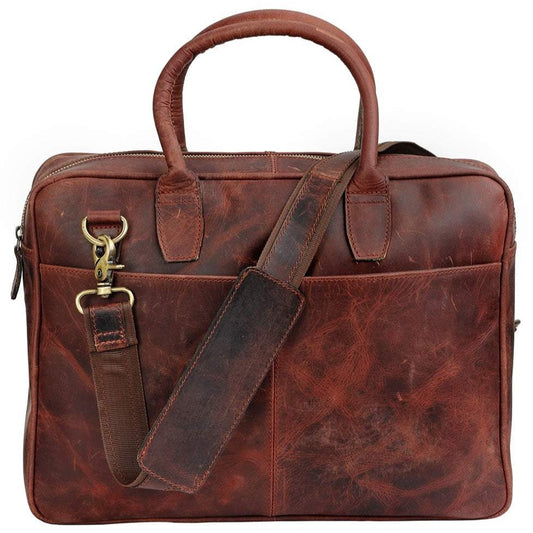
Zippers and clasps get most of the attention in hardware discussions, but the components that actually bear continuous load, the D-rings, rectangular rings, and strap attachment hardware, are where many bags fail first.
A D-ring is only as good as the loop of leather or webbing it sits in, and that loop is only as good as the stitching and riveting that secures it to the bag body.
The weakest link in this chain is almost always the attachment point, not the ring itself.
On quality bags, strap attachment points are reinforced with a backing plate or a doubled-leather gusset on the interior of the bag wall.
The stitching through this point is dense and often box-stitched for shear resistance.
The rivets, if present, pass through both the leather and the backing plate and are set, not just pressed.
On budget bags, attachment points are often a single layer of leather with a simple bar-tack stitch and no reinforcement.
This is adequate until the strap bears sustained weight, at which point the stitching pulls through the leather rather than the stitch breaking, which is a much harder repair.
The pull test mentioned in the WHAT YOU NEED TO KNOW section is the most reliable in-store check.
Grip the D-ring or strap attachment and pull firmly in the direction the strap would pull under normal carry load. On a quality bag, nothing moves.
On a budget bag, you will feel flex or slight movement at the connection point, which indicates the reinforcement is minimal.
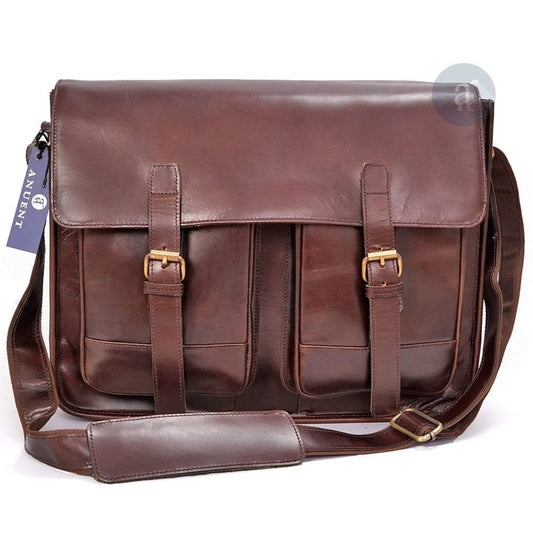
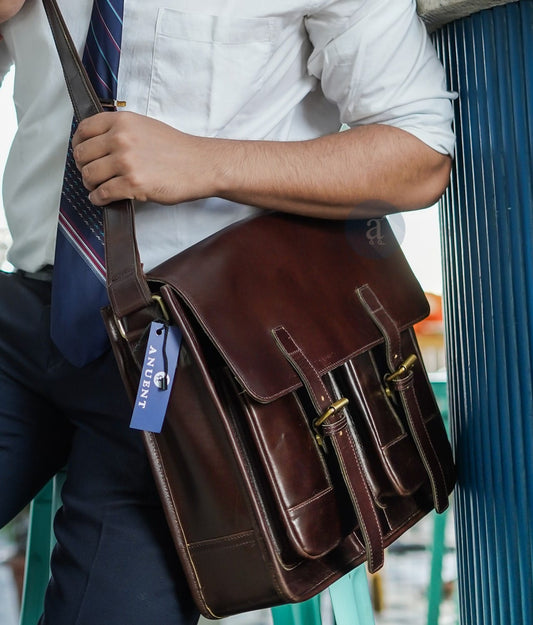
This is particularly important on bags intended for heavy daily use, like a leather messenger bag for men that bears a laptop and daily carry across one shoulder, or structured men's leather attache case options where the top handle carries the full weight of documents and a laptop repeatedly across a working week.
Clasps, Turnlocks, and Magnetic Closures
Bag closures beyond the zipper fall into three categories: turnlocks, push-closures, and magnetic snaps.
Turnlocks are the most durable closure type for daily-use bags. They engage mechanically and do not rely on spring tension or magnetic attraction. A quality turnlock rotates smoothly, locks with a definite click, and requires deliberate action to open. A budget turnlock feels loose in its mount, wobbles when rotated, and may disengage under the movement of normal carry.
Push-closures, also called press-studs or snap closures, use a spring mechanism that compresses when pressed. The quality range is wide. A quality push-closure has consistent spring tension, a clean engagement click, and a flush fit between the male and female components. A cheap push-closure develops inconsistent spring tension within months, starts to engage partially rather than fully, and eventually fails to hold closed under the weight of bag contents pressing outward against the flap.
Magnetic snaps are the most convenient closure type, but the least durable under sustained use. Quality magnetic snaps use a stronger magnet seated in a solid brass housing. Budget magnetic snaps use a weaker magnet in a thin stamped-metal housing that bends over time, reducing magnetic contact and eventually allowing the closure to open under moderate pressure.
Magnetic snaps should not be used as the primary closure on bags that carry electronics, as the magnet can affect older magnetic storage media, though this is rarely a practical concern for most daily carry items.
How to Read Hardware Quality in Product Photography
When buying online, physical tests are not available.
There are several things you can read from product photography that indicate hardware quality without handling the bag.
The reflective quality of metal surfaces is the first indicator.
Genuine brass hardware in product photography has a warm, slightly muted gold tone.
Chrome-plated zinc alloy tends toward a colder, harder reflective surface.
Neither is definitive, but a bag positioned as premium that photographs with cold chrome hardware is worth scrutinizing further.
Zipper pull detailing is readable at normal zoom.
A YKK zipper pull has a rectangular body with the YKK logo debossed or embossed on the face.
Budget zipper pulls are often smooth on all faces or have a stamped generic pattern with no brand identification.
Check the product photography at full zoom on the zipper area before purchasing any bag where the zipper will see daily use.
Stitching density at attachment points is visible in close-up photography.
Count the stitches per centimeter at a D-ring attachment or strap loop.
A higher stitch count indicates denser, more shear-resistant stitching.
Widely spaced stitches at attachment points are a visual indicator of a cost-reduced construction approach.
The leather bag quality checklist from r/BuyItForLife covers the full set of pre-purchase checks, including hardware, leather grade, stitching, and lining quality, in one consolidated reference.
Hardware Finishes and What They Tell You
Hardware finish is the surface treatment applied over the base metal.
It affects appearance, corrosion resistance, and how the hardware ages.
Polished brass or gold finish is the most common on classic leather goods. It looks bright when new and shows wear at contact points over time, which many buyers prefer as it gives the hardware a lived-in character that matches leather patina development.
Antique brass finish is a darkened or patinated version of brass that arrives pre-aged. Because it is already darkened at the high points, additional wear from handling is less visible. Antique brass tends to maintain its appearance longer than polished brass in terms of looking intentionally finished rather than worn.
Gunmetal and matte black finishes are applied over brass or zinc alloy. On zinc alloy, these finishes wear through at contact points, revealing the grey base metal beneath, which is more visible against a dark finish than against a gold one. On brass, the same surface wear reveals warm gold beneath the dark treatment, which can look intentional. Knowing the base metal is therefore more important than the finish color for predicting how hardware will age.
Nickel-plated finishes are common on lower-cost hardware. Nickel is a known contact allergen for approximately 15 to 17 percent of the population, according to dermatological research. For bags where hardware contacts skin regularly, particularly crossbody bags with metal hardware at chest height, nickel-free hardware or hardware coated with a hypoallergenic finish is worth specifying.
Quality leather goods brands typically specify nickel-free hardware in their product descriptions, which is a detail worth checking.
Putting It All Together: The Hardware Check Before You Buy
The following checklist covers what to verify before purchasing any leather bag where hardware longevity matters.
- Check the zipper slider for a manufacturer's marking. YKK, RiRi, or Lampo indicates quality. No marking indicates a budget component.
- Run the zipper back and forth. It should glide without resistance, skipping, or lateral flex at the pull hinge.
- Weigh the hardware mentally. Solid brass has noticeable heft. Lightweight hardware is zinc alloy regardless of its color.
- Apply the pull test to every strap attachment point. No movement on a quality bag. Any flex indicates minimal reinforcement.
- Check closure function. Turnlocks should definitely click. Push closures should have consistent spring tension. Magnetic snaps should hold without effort.
- Zoom into product photography at the zipper and D-ring areas. Check for logo markings on the zipper slider and stitch density at attachment points.
- Read the product description for hardware material specifications. "Solid brass hardware" and "YKK zippers" in the description indicate a manufacturer who considers hardware a selling point rather than an afterthought.
For daily-use bags, applying this checklist prevents the most common leather bag disappointment: a bag that looks and feels excellent for six months and then loses a zipper, a buckle, or an attachment point that cannot be easily replaced or repaired.
Quality hardware is not a premium feature on a bag you carry every day.
It is a baseline requirement.
You can read more about spotting the broader range of construction quality issues in the guide to identifying a fake leather bag before you buy, which covers stitching, lining, and leather surface tests alongside hardware.
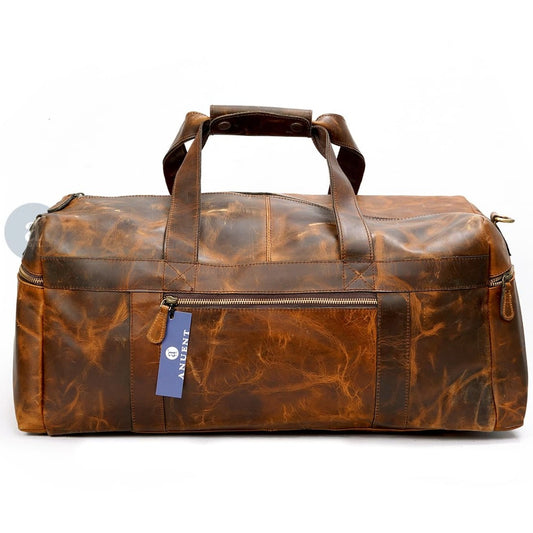
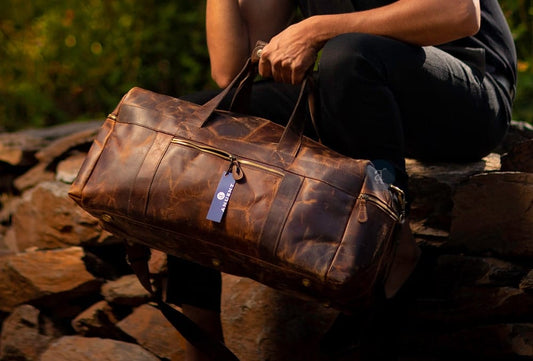
For leather bags where hardware quality is built into the construction from the start, the mens leather work bag and leather duffel bag for men collections include full hardware specifications in the product descriptions so you can verify the details before purchasing.
The American Association of Textile Chemists and Colorists publishes testing standards that cover metal hardware corrosion resistance, which gives a useful background on how material performance claims in the accessories industry are validated.
For an in-depth look at how leather grades interact with hardware quality in determining a bag's total lifespan, the guide to types of leather used in different bag constructions covers the material side of this question in full.
HARDWARE THAT HOLDS
Bags Built With Brass Fittings and Quality Zippers Throughout
Every Anuent bag is expertly crafted with hardware specifications listed on each product page. Free shipping to the USA, UK, and Canada. Free monogramming on every order.
FAQ
What zipper brand should I look for on a quality leather bag?
YKK is the benchmark zipper brand for quality leather goods at most price points.
YKK produces zippers for everything from outdoor performance gear to high-end fashion houses because their consistency and failure rate are measurably better than most competitors.
Other quality zipper brands include RiRi (Swiss, used on luxury goods) and Lampo (Italian).
A zipper with no brand marking on the slider is almost always a lower-grade component produced to lower tolerances.
How can I tell if bag hardware is solid brass or zinc alloy?
Weight and temperature response are the two most reliable field tests.
Solid brass has noticeable heft for its size and warms quickly in your hand because of its higher thermal conductivity.
Zinc alloy feels lighter for the same volume and takes longer to warm.
A magnet confirms the absence of steel, but does not distinguish between brass and zinc alloy since both are non-magnetic.
If a product description specifies "solid brass hardware," that is a manufacturer's claim worth noting, but the weight test gives you physical confirmation.
Does hardware finish color indicate hardware quality?
No. Finish color and base material are entirely separate.
A gold-colored finish can be applied over solid brass, zinc alloy, or, in some cases, treated plastic.
A dark gunmetal finish can sit over brass or over zinc alloy.
The only reliable indicators of base material are weight, temperature response, and an explicit material specification from the manufacturer.
Finish color predicts how the hardware will look when new, not how long it will last.
What is the most common hardware failure point on leather bags?
Strap attachment points, specifically the D-rings, rectangular rings, and strap loops where the shoulder strap connects to the bag body, are the most common hardware failure point on budget leather bags.
The hardware itself rarely fails first. What fails is the attachment: the stitching loop, the rivet setting, or the leather gusset that holds the D-ring in place.
On quality bags, these attachment points are reinforced with backing plates and dense bar-tack or box stitching.
On budget bags, they rely on a single layer of leather and minimal stitching, which pulls through under sustained carry weight.
Are magnetic snap closures reliable for daily use?
Magnetic snaps are the most convenient closure type, but not the most durable under heavy daily use.
Quality magnetic snaps use a strong magnet in a solid housing that maintains a consistent hold.
Budget magnetic snaps use weaker magnets in thin housings that bend over time, reducing magnetic contact and allowing the closure to open under moderate bag content pressure.
If a bag's primary closure is a magnetic snap rather than a zipper or turnlock, the quality of the snap housing is worth checking specifically before purchasing.
Does hardware quality affect how long a leather bag lasts overall?
Yes, significantly, and in most cases, hardware fails before the leather does on bags that are otherwise well-made.
A top-grain buffalo leather bag body can outlast its hardware by years if that hardware is made from cheaper materials.
A zipper that splits, a buckle that snaps, or a D-ring attachment that pulls away from the bag body can render a structurally sound leather bag non-functional before the leather itself shows serious wear.
Hardware quality is not a secondary consideration on a bag you intend to use daily for five or more years.
It is part of the total lifespan calculation.
What should I look for in strap hardware on a shoulder bag or messenger?
The three things to verify on the shoulder and messenger bag strap hardware are the ring material, the adjustment buckle mechanism, and the attachment point construction.
The ring should be solid brass or solid steel, heavy for its size, and have no flex or movement when you pull on it firmly.
The adjustment buckle should slide smoothly, hold position under load without slipping, and have a prong or cam mechanism that grips the strap positively rather than relying on friction alone.
The attachment point where the strap meets the bag should show reinforced stitching, a backing plate visible from the inside, and no flex when you pull in the direction of normal carry load.
BUILT TO LAST DAILY USE
Leather Bags Where the Hardware Is as Durable as the Leather
Every Anuent bag is expertly crafted from top-grain buffalo leather, goat leather, and vegetable-tanned leather with hardware quality detailed on every product page. Free shipping to the USA, UK, and Canada.